

The Taylor Theatre Playbills collection features programs from Taylor’s stage productions, including Taylor Theatre, musicals, playback theatre, and Taylor’s Touring Company. Some operas are also included.
























-
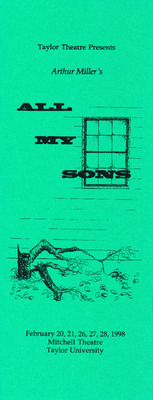
All My Sons
The playbill for Taylor University’s Fall 1968 performance of All My Sons by Arthur Miller.
All My Sons is the story of the Keller family, whose father knowingly sent a batch of defective engine cylinder heads to the military in World War II, and how the discovery of his crime impacts his family and neighbors.
-
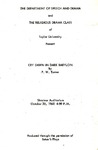
Cry of Dawn in Dark Babylon
The playbill for Taylor University’s Fall 1968 performance of Cry Dawn in Dark Babylon by P. W. Turner.
From the playbill: “According to the author, this is a play about death, the Resurrection and the Church. It is a true story, based on his own experience as a pastor in an industrial parish in England.”
Performed by the Taylor Religious Drama Company. It was second of three projects developed by the class for the semester.
-
The Potting Shed
The playbill for Taylor University’s Fall 1967 performance of The Potting Shed by Graham Greene.
The Potting Shed tells the story of a man who returns home to his estranged family as his father is dying. Unsure why he was estranged from his family, he pursues answers his family will not provide. He realizes the answer is found in his blank memory about an event in a potting shed when he was fourteen.
-
The Rivals
The playbill for Taylor University’s Spring 1967 performance of The Rivals by Richard Brinsley Sheridan.
The Rivals tells the story of young lovers, Lydia Languish and Captain Jack Absolute and the mishaps which happen when Jack’s father tries to arrange a marriage for him and a sequence of gossip and misdelivered letters sets off a clash between Lydia’s suitors.
This show was performed by the Faculty Readers reader’s theater.
-
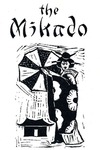
The Mikado
The playbill for Taylor University’s Spring 1967 performance of Mikado by W.S. Gilbert and Arthur Sullivan.
The Mikado is the comic opera about the romance between Nanki-Poo, the son of Japan’s Mikado, and Yum-Yum, the ward of the High Executioner of Titipu.
-
An Evening of One-Act Plays
The playbill for Taylor University’s 1966 student-directed productions, including The Shoemaker’s Wife translated by David Thompson, The Starting March by Jerry McNeely .
-
The Master Builder
The playbill for Taylor University’s Fall 1966 performance of The Master Builder by Henrik Ibsen.
The Master Builder tells the story of Halvard Solness, the master builder in a small Norway town who meets a young woman whom he made advances on early in life and takes into his home.
This show was performed by the Faculty Readers reader’s theater.
-
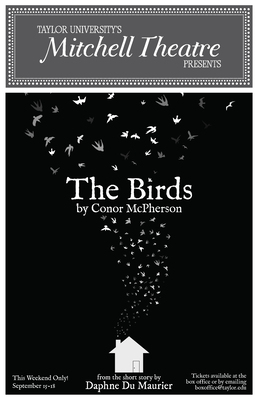
The Birds
The playbill for Taylor University’s Fall 1966 performance of The Birds by Aristophanes.
The Birds tells the story of two Athenians who are tired of their life among the gods and people and seek a king who became a bird, that they may form an allegiance with the birds form a city of their own.
-
The Fantasticks
The playbill for Taylor University’s Spring 1966 performance of The Fantasticks with music by Harvey Schmidt and book and lyrics by Tom Jones.
The Fantasticks is an allegorical musical about two scheming neighbor fathers who pretend to feud in order to make their children fall in love.
-
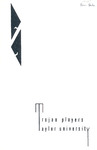
An Evening of One-Act Plays
The playbill for Taylor University’s 1965 student-directed productions, including The Apollo of Bellac by Jean Giradoux, Long Stay Cut Short by Tennessee Williams, and The Valiant by Holsworthy Hall and Robert Middlemass.
-
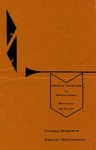
Hedda Gabler
The playbill for Taylor University’s Spring 1965 performance of Hebba Gabler by Henrik Ibsen.
Hebba Gabler is the story of newlywed Hedda Tesman and her reunion with a former lover and how she manipulates events to secure and create a life for herself with her husband.
-
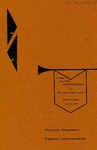
The Cave Dwellers
The playbill for Taylor University’s Fall 1964 performance of The Cave Dwellers by William Saroyan.
The Cave Dwellers tells the story of four homeless persons living on the stage of a theater about to be torn down, and how they recount the memories of their better days with joy.
-
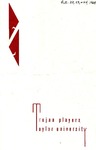
Arsenic and Old Lace
The playbill for Taylor University’s Fall 1964 performance of Arsenic and Old Lace by Joseph Kesselring.
Arsenic and Old Lace is the story about the Brewsters, an insane homicidal family, and the one sane member, Mortimer Brewster, who must decide whether or not to go through with his promise to marry the woman he loves, Elaine Harper, who lives next door.
-
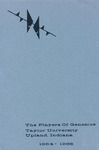
The House by the Stable
The playbill for Taylor University’s Players of Genesius 1964-1965 performances of The House by the Stable by Charles Williams.
-
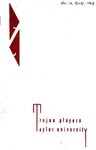
The Dark at the Top of the Stairs
The playbill for Taylor University’s Fall 1963 performance of The Dark at the Top of the Stairs by William Inge.
The Dark at the Top of the Stairs is the story of Cora Flood, the wife of a traveling salesman. Learning that her husband might have an affair with another woman, she plans to leave the marriage. When her husband returns, having lost his job, Cora must decide how to respond.
-
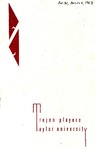
The Heiress
The playbill for Taylor University’s Fall 1963 performance of The Heiress by Ruth and Augustus Goetz adapted from the 1880 Henry James novel Washington Square.
The Heiress tells the story of Catherine Sloper, a rather plain-looking woman set to receive a large inheritance from her father. When a man comes to court her, her father suspects it is for the money and attempts to thwart his plan.
-
Right You Are
The playbill for Taylor University’s Spring 1963 performance of Right You Are by Luigi Pirandello, translated by Eric Bentley.
Right You Are is the story of Mr. Ponza and his mother-in-law, Lady Frola, and the attempt by their village to determine the truth behind their story, as each claims the other is insane.
-

Three by Ionesco
The playbill for Taylor University’s Fall 1962 performance of Three by Ionesco, featuring Man's Futile Effort, The Lesson, and The Chairs by Eugéne Ionesco, translated by Donald M. Allen.
-

The Miser
The playbill for Taylor University’s Fall 1962 performance of The Miser by Molière, adapted by Miles Malleson.
The Miser tells the story of old man obsessed with wealth, determined to marry a young woman who is actually in love with his son, and marry his daughter to a rich man, though she is in love with someone else. As the children are trying to live according to their own designs, events are complicated further when the miser’s hoard is stolen.
-
The Crucible
The playbill for Taylor University’s Spring 1962 performance of The Crucible by Arthur Miller.
The Crucible is a fictional story of the Salem Witch trials, telling the deterioration of a Massachusetts town when a group of women are accused of practicing witchcraft. Millar wrote the play as an allegory for McCarthyism.
-
The Importance of Being Earnest
The playbill for Taylor University’s Spring 1962 performance of The Importance of Being Earnest by Oscar Wilde.
The Importance of Being Earnest, A Trivial Comedy for Serious People, is a farcical comedy about two men who each take on the personas with the name of Earnest in order to escape the burdens of social obligations.
-
Ladies in Retirement
The playbill for Taylor University’s Fall 1961 performance of Ladies in Retirement by Edward Percy and Reginald Denham.
Ladies in Retirement tells the story of a retired actress living in a remote home with her housekeeper and maid, and what happens when the housekeeper invites her two rambunctious younger sisters to live with them.
-
The Hasty Heart
The playbill for Taylor University’s Fall 1961 performance of The Hasty Heart by John Patrick.
The Hasty Heart tells the story of a group of Allied soldiers in a temporary British hospital after World War II, and their efforts to befriend a rather distant soldier with a terminal illness.
-
J.B.
The playbill for Taylor University’s Spring 1961 performance of J.B. by Archibald MacLeish.
J.B. is a retelling of the Biblical story of Job by two old circus performers by the name of Zuss and Nickles (Zeus and Satan), who make a wager and play out Job’s story in modern America where Job is a millionaire named J.B..
This was part of the 1961 Fine Arts Festival and performed in Maytag Auditorium.
-

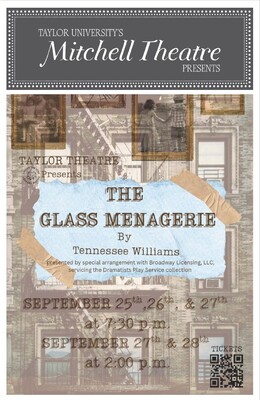
The Glass Menagerie
The playbill for Taylor University’s Spring 1961 performance of The Glass Menagerie by Tennessee Williams.
The Glass Menagerie is a memory play narrated and led by a young man named Tom, who recounts life with his mother Amanda and sister Laura. The play has strong autobiographical elements of the playwright Tennessee and his experience growing up with his mother and sister.